5 questions CPG brands must answer to master Instacart


It is no surprise that with 85% of the US and 70% of Canadian households covered, the major CPG brands are listing Instacart as one of their top retail partners.
The impact of the Instacart shopper on CPG revenues is likely to grow more significant as they add new retail partners, innovate with delivery options and diversify product offerings.
Unfortunately, it is the very uniqueness of Instacart and other 3rd party delivery services that is making it a sore spot for many brands to manage.
Working with several brands and retailers we find that most have significant blindspots when it comes to what is happening with their brands, and their competitors, on Instacart.
That said, brands that can answer these 5 questions can more effectively build an Instacart account strategy that drives revenue and meets customer needs.
1. Are your products and competitive set matched properly with Instacart’s catalog?
Data quality due to mismatched products is the most prominent reason for difficulties assessing your Instacart business. Product matching with Instacart is challenging because you not only need to understand regional influence and the available options for retail store fulfillment, but also the unique data formatting that Instacart uses on their platform. Without this any decisions you make about pricing, availability, assortment, etc. risk being flawed.
2. Can I access zip-code level granularity of Instacart pricing, promo and assortment data understand regional competitive differentiation?
Instacart, like most traditional retailers, operates through a local or regional lens. Therefore, an inability to view Instacart with local granularity provides a misaligned or misconstrued illustration of what your shopper experiences. Instacart does not make access to this zip-code level data easy to preserve the integrity of the shopping experience, but your ability to use this data to monitor and build pricing and promotional strategies is a significant advantage.
3. How are your in-store promotional plans being represented on Instacart?
Promotional spending remains the #2 line-item for brands. Now, brands are faced with additional investment in keywords and coupons directly on the Instacart platform. These are easy to monitor. However, investing in an in-store promotion with a retailer comes with expected lift in sales. If the item is purchased through Instacart instead of directly at the store, how do you know if the promotion passed on to the customer? Without the data, this question often leads to finger pointing between retailer, Instacart and your sales team.
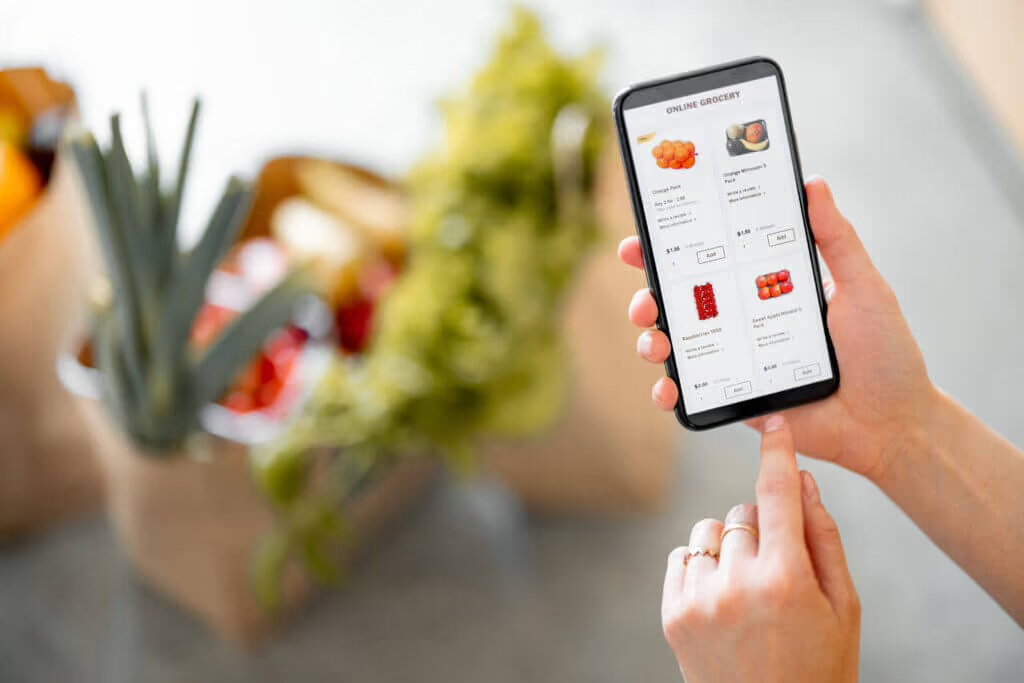
4. How does you Instacart shopper impact your in-store availability?
In the world of e-commerce “out of stock” does not necessarily mean not on shelf.
This is something that most brands navigate. However, since Instacart fulfillment happens at the store level understanding how pricing and promotion on Instacart and across retailers Instacart shops from impacts yours’ and your competitors’ availability and subsequently your discoverability and sales is critical.
5. How are my promotional strategy and competitive set impacting my discoverability on Instacart?
Much is still being learned about how shoppers shop online, but there is no doubt that shoppers cannot buy what they cannot find.
Being found on Instacart and other online retailers is not as simple as being present on a store shelf and requires the right data to know how your price, content, keywords, assortment and availability impact your ranking, but also how the same metrics (and changes to them) impact your ranking.
Just like if your shoppers can’t find you then they can’t buy you, if you can’t see the components that affect your ranking then you can’t change how easy it is to see you.
Meeting Shoppers Where They Are
Availability to accurate data has been a struggle between retailers and brands because accessibility was limited. E-commerce and delivery service has broken the accessibility barriers down, but added complexity to the 4Ps (product, placement, price, promotion) with more options than ever.
For brands to be successful in an Instacart world, they must learn how to not just access the wealth of data available, but also glean insights to make decisions to meet shopper needs and grow revenue.
This means not having to invest in teams of people to overcome when an Instacart or other retailer changes their site or repurposing analysts to do product matching or data cleansing.
Instead, it’s finding a data partner that both are experts in scaling the most hard-to-access omni-channel data processes and understands how to deliver it a way that makes it actionable for your business. Whether Instacart is a brands ally or foe is yet to be determined.
For now, they have taken the lead in delivering what shoppers want, when and where they want your products. As a result, answering these 5 questions to best manage Instacart is also the best path to meet your consumers where they are today.
Related articles


See it on your own data
Bring your categories and competitive set. See what the model recommends, and why.