Why Rule-Based Pricing Keeps You Grounded
Reading Time: 13 Minutes
Post written by IDC.com

Price is the paramount factor for consumers making purchasing decisions. Price continues to the be the primary lever that retailers have to influence customer behavior. Retailers that can master the price engagement with customers command the market.
Grocers operate on a variety of pricing strategies – from everyday low price (EDLP) to hi-low pricing retailers like regional grocers that operate with circulars and continuous promotions, sales, discounts, coupons, special deals, and bundles. Retailers must price correctly to influence consumers to meet their strategic aims. Price continues to be a key incentive for consumers in value pricing and impulse buys. The retailer, however, is challenged with several issues that burden its ability to capture customer sales.
Grocery Price Challenges
Grocery is an especially price-sensitive space. Why? Because the frequency of consumers purchasing groceries is high. According to FMI data, the average consumer buys groceries weekly while rent and gas are purchased monthly.
Shifts in price, even week to week, would not only be noticeable by consumers but also redirect spending. Customers must still buy their cereal, cut of meat, and orange juice for general sustenance. Despite scarcity of resources, food usually is first on the menu before most other expenses. The consumer will budget available funds and carefully select stores and products.
Competition in grocery is also fierce. The typical grocer uses millions of data points from transaction logs, trade promotions, weather, loyalty, and cost data. These data points are digested to manage thousands of SKU prices across hundreds of stores and dozens of store formats, usually under multiple retail banners, online channels, and in highly localized stores.
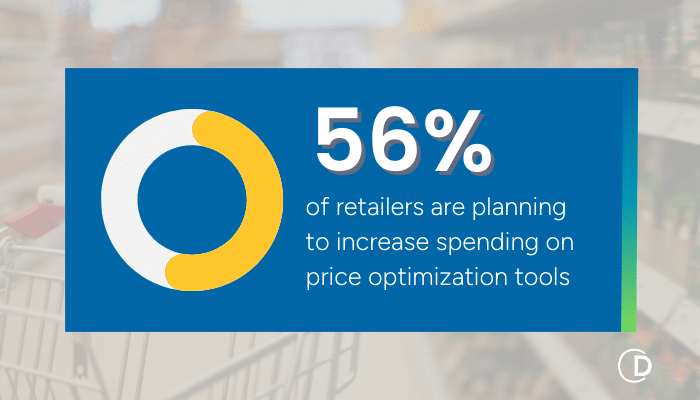
Leading grocers rely on price optimization tools to process data at scale to achieve business performance goals. There is enormous reliance on tools that can engineer price points across thousands of items and correlate them in real-time for a retailer. The 2025 IDC Global Retail Survey shows over 56% of retailers are planning to increase spending on their price optimization tools in the next year.
Promotions Are Critical
Promotions are a mainstay for many retailers.
A typical grocer with a hi-low price strategy is continuously running promotions to drive purchase behavior, dropping prices on key value items (KVIs) that bring customers to the store, such as staple goods like milk or eggs. A grocer might be running 10,000-20,000 promotions annually, with sophisticated promotions calendars, differentiation across locations or banners, and challenges to timing and availability of product.
Promotion optimization tools are critical to orchestrate the combinations of products, integrate these with regular price points, and make sure these can manage to competitor promotions. Depending on the retailer’s maturity, a price or promotion optimization tool can provide retailers with margin improvements from 2-10% in the first year alone, with subsequent incremental improvements over time.
While price/promotion optimization tools are highly sophisticated solution engines, they are not based strictly on AI/ML or some form of magic calculators that compute price elasticity (the elastic nature of price to volume sold). The key engines build on sets of rules that are typically set by retail merchants and pricing analysts with experience in understanding product, price, and correlative properties across products.
Rule-Based Retail Price Strategy
Four key strategic aims for any price strategy – improve revenue, profits, market share, or sell-through – are driven primarily through rules.
Retailers must first know what the market will bear, so demand forecasting is important. Automation of pricing then follows elasticity and other factors to help shape the necessary pricing outcomes. However, even the elasticity or perceived price value for a product must follow a set of rules to execute a price strategy. Algorithms alone cannot define a strategy, except one that is driven completely by consumer demand. These algorithms are bound by human-set rules and guardrails to ensure that consumers aren’t ultimately offered products for free.
A typical price optimization solution will have thousands of rules and different kinds of rules such as hard rules, soft rules, rule prioritization, stacked rules, rule disqualifications, and rule overrides. Special rules also exist to reduce risk, improve strategic aims, or manage conflicting rules such as:
- Margin thresholds
- Competitive match
- Private brand bias
- Stockout guardrails
- Banner specific pricing
Rules management is key to retail success as planners and merchants must guide enormous data sets with hundreds of thousands of price points. This means delivering a constrained optimization model that ensures that the retailer can achieve their strategic objectives. Rules incorporate customer behavior and must be adaptable. To accomplish this requires automation, intelligence, and flexibility while keeping the customer in mind.
The most effective rules engines are often hybrid solutions that leverage AI/ML algorithms along with rules. The ability to change intelligently becomes an important advantage to manage such volumes of pricing in an ever-changing customer and retail environment.
The New AI-Driven Price Architecture
New technologies, with potential price optimization capabilities, have arisen through generative AI (GenAI) and agentic AI. Most are still offering only an interface to the pricing and promotion tools rather than actual pattern recognition or rule development and delivery. IDC’s Global Retail Survey asked where GenAI can have the most impact from a financial or KPI perspective: Price/promotion/markdown optimization was ranked the highest by over 35.7% of respondents. The next phase of such technologies will influence how price/promotions will be managed, not as part of the computational algorithms that have been perfected over decades using predictive AI and ML, but as part of the advanced rules established to drive price optimization and promotion strategic aims.

Price will remain the key lever for retailers to influence consumer behavior while new technology continues to infuse the retail market. AI capabilities will automate rule management plus overlay price elasticity and other computational advantages toward key strategic aims. Automated rules will eventually enable pricing leaders to eliminate managing individual price points by product and allow for more personalized pricing to consumers based on all the attributes to sell the product. We will see higher-level thinking by pricing analysts, merchants, or planners at grocery retailers going forward. These changes will begin to automate the critical rule structures that retailers have developed and allow for higher volume, more personalized, real-time pricing in the future. Regardless of how consumers perceive the price of coffee, retailers will leverage these price innovations to meet their customers with the right price.
ClearDemand supports grocery retailers as you navigate increasingly complex pricing environments shaped by competition, shifting demand, and operational constraints. Our platform applies rule-based logic, demand modeling, and competitive insights to help pricing and merchandising teams make informed, optimized decisions at scale. We work with you to align pricing actions with strategic goals while maintaining consistency across banners, channels, and store formats. Learn more about ClearDemand’s retail pricing solutions.


Why Rule-Based Pricing Keeps You Grounded
Post written by IDC.com Price is the paramount factor for consumers making purchasing decisions. Price continues to the be the primary lever that
Read
Retail Pricing Optimization: The Trends Reshaping Grocer Profitability
Heading into 2026, grocers face a familiar but complex challenge: balance profit, perception, and price image in a market that won’t settle. Even as inflation slows,
Read
Holiday 2025: Pricing Mistakes Retailers Can’t Afford
The 2025 holiday season will test every retailer’s pricing strategy. Shoppers are spending less and thinking harder about every purchase. PwC projects a
Read
Groceryshop: The Future of Grocery is Centered on Value
At Groceryshop 2025, one message came through loud and clear: Shoppers haven’t stopped buying, they’ve just changed how they define value. Across stages,
Read
Everyday “Fair” Pricing – The End of Hi-Lo as We Know It?
Is Alix Partners on to something? Every shopper loves a deal and today, finding one only takes a swipe. With smartphone in hand,
Read
Master Pricing: The Blueprint for Grocery Price Optimization
“The days of spreadsheets and gut-feel pricing are behind us,” said Steve Thornberry, VP of Sales at ClearDemand. “Retailers need science-backed decisions that
Read
5 Tips for a Profitable Price Optimization Strategy
Pricing isn’t just some number. It’s not copying the competition’s prices. It’s not repeating last year’s strategy. It’s a strategic weapon that can
Read
Tariffs Hit the Shelves: How Retailers Can Stay Ahead
The retail industry is feeling the pressure as tariffs on Mexico, Canada, and China drive up costs across multiple categories. Groceries, auto parts,
Read
Grocery Pricing’s Moneyball Moment
The pop of a catcher’s mitt, the crack of a bat, and of course, a hot dog. Yes, baseball – my favorite time
ReadThe Latest Insights – Straight to Your Inbox
Sign up for the ClearDemand mailing list for actionable strategies, upcoming events, industry trends, and company news.