2026 grocery pricing readiness checklist: Compete smarter with data, elasticity, optimization

With new year planning underway, grocery category managers and pricing teams are asking,
» Where do my prices stand in the market?
» Where am I overpriced or underpriced compared to my competitors, especially on KVIs?
» Are elasticity signals shifting anywhere?
» How do I make sure pricing rules don’t block revenue opportunities?
We've built this pricing readiness checklist that outlines the foundational capabilities grocery retailers need to compete effectively and protect margin in 2026.
A Defining Year for Grocery Pricing
2025 was a year that pushed grocery pricing teams to rethink how they operate.
Inflation reached its highest point in two years, and more than 80% of shoppers said they felt grocery prices were still rising. Many shifted their baskets toward value, which helped private label shed its “knockoff” reputation and become a trusted choice.
Tariffs added another layer of cost pressure, forcing grocers to look closely at how and where they pass increases through.
The industry also saw other major headlines: Kroger’s CEO stepped down and the unsuccessful Kroger-Albertsons merger. C&S Wholesale announced plans to merge with SpartanNash and took over the remaining Winn Dixie stores, creating new dynamics in several regions. Instacart and its pricing arm, Eversight, faced scrutiny over controversial pricing tests. UNFI fell victim to a cyberattack. Changes were made to the SNAP program.
All of these headlines make pricing more important than ever.
More than half of grocery shoppers say they are definitely spending more, 7 in 10 US adults are worried about grocery prices, and the food at home CPI climbed another 2.7% in 2025.
Shoppers are alert to every price change.
They compare across channels, shift to value options, and pay close attention to your KVIs. Executing optimized prices should be a priority without being a race to the bottom because the best price is rarely the lowest or highest... It's the price that aligns with demand, competition, and value perception.
Seeing how fierce the landscape is, grocers are investing in AI-powered retail pricing tools.
Industry research showed that retailers increased spending on AI-driven pricing and competitive intelligence solutions as they worked to keep pace with shifting demand and market changes.
Teams want demand models they can trust, competitive pricing data they can act on, and pricing workflows that make responding to change effortless. The goal is to set the right prices and execute them with confidence.
Pricing readiness comes down to whether your team has the right capabilities in place to understand demand, respond to competition, and execute prices confidently across categories and channels. The checklist below is designed to help grocery leaders assess those capabilities:
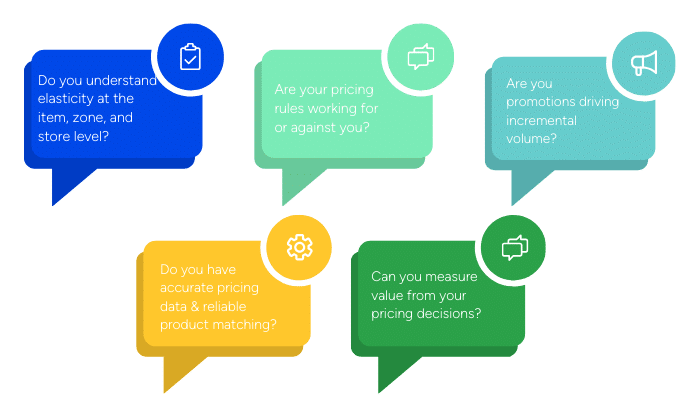
1. Do You Understand Elasticity at the Item, Zone, and Store Level?
Elasticity is one of the clearest indicators of how price affects shopper behavior. It tells you how demand shifts when you move a price up or down. This signal changes because shopper missions, competitive gaps, trip frequency, and promotions all influence how sensitive an item is at any moment. That’s why elasticity should be treated as a live signal, not a point-in-time calculation.
ClearDemand captures how shoppers respond to price changes at the item, category, and zone level.
These models predict how any price move will impact unit sales, revenue, and margin. And the models update as demand patterns shift, which means elasticity reflects current shopper behavior rather than past assumptions. This approach gives you clarity on where you can take small increases or where sharper pricing is needed to protect value perception.
2. Are Your Pricing Rules Working For or Against You?
Once demand has been modeled, the next step is optimization. This is where AI evaluates thousands of potential price combinations and recommends the ones that best achieve your goals, whether it's higher margin, stronger price image, more unit movement, or competitive alignment. But these recommendations don’t exist in isolation. They operate within your real business constraints.
ClearDemand uses constraint-based optimization, which honors both hard and soft pricing rules.
Hard rules might include price thresholds, vendor agreements, minimum margin floors, and competitive requirements. Soft rules might reflect brand consistency, price endings, price gap strategies, or shopper perception guidelines.
This structure ensures that your prices prices reflect your business logic. Instead of rules acting as roadblocks, they become strategic guardrails that enable better decisions.
3. Accurate Competitive Pricing Data With Reliable Product Matching?
Competitive pricing is one of the strongest signals shoppers use to judge value. But many retailers still operate with incomplete or inaccurate competitive intelligence.
ClearDemand combines AI product matching with competitive data collection designed specifically for grocery categories and formats.
Our models identify true like-items, align sizes and formulations correctly, and flag mismatches that could distort competitive gap decisions. The result is a clean, trusted competitive view across your market. When competitive intelligence is reliable, your pricing strategy becomes more confident, consistent, and informed.
4. Are Your Promotions Driving Incremental Volume?
Promotions are one of the most visible levers for influencing shopper behavior, but they are also one of the easiest ways to unintentionally destroy margin. Many promos appear successful because volume lifts, but without understanding elasticity, affinity, cannibalization, and baselines, it's almost impossible to tell whether the promotion created true incremental value.
ClearDemand’s promotion optimization analyzes how shoppers respond to deals, which items drive cross-category lift, and where promotions are simply shifting sales from full-price items to discounted ones. Using these insights, retailers can prioritize offers that increase basket size, build trip frequency, and reinforce value perception.
5. Can You Measure Value from Your Pricing?
Many teams lack the reporting needed to measure pricing's true impact.
Without visibility into what changed, why it changed, and how performance shifted, it’s difficult to prove ROI of price optimization solutions or identify opportunities to improve.
ClearDemand quantifies the impact of pricing decisions at the item and category level.
You can see how margin moved, how volume responded, how competitive gaps improved, and how elasticity signals evolved. Instead of manually assembling reports from multiple systems, teams get a consolidated view that shows whether pricing decisions delivered the intended outcome.
What High-Performing Grocery Retailers Are Doing Differently
High-performing grocers are pulling ahead by using data science to make faster, more confident pricing decisions. Instead of reacting to competitors after the fact, they use competitive intelligence, demand modeling, and optimization to anticipate where prices should move and why.
Across the market, top pricing and merchandising teams share a common playbook:
- Treat elasticity as a dynamic, real-time signal
- Align competitive gaps with the customer experience
- Connect pricing, promotions, and competitive intelligence in one system
- Run scenarios to stay ahead of cost changes and competitive shifts
ClearDemand Helps Grocers Enter 2026 With Confidence
ClearDemand was built for grocers who need accurate science, depth of data, and faster ways to make pricing decisions that hold up in a competitive market.
Grocery-native pricing science is at the heart of the platform. We model demand and elasticity to understand how your shoppers are reacting to price changes. We work with you to apply rules as strategic guardrails then optimize prices within these constraints to recommend actions that balance margin, volume, and price image. ClearDemand's price engine delivers integrated competitive intelligence. We ingest competitive data natively, link items accurately, and give our customers a cleaner, more reliable view of their market position. While other platforms depend on third-party data feeds, ClearDemand gives retailers a true competitive data advantage.
Our data flexibility is another differentiator. We have the ability to clean, map, and ingest retailer data even when formats are nonstandard or incomplete. This means you don’t wait months to get value.
→ Ready to see how 2026 pricing readiness looks for your organization? Let’s talk.
Related articles

See it on your own data
Bring your categories and competitive set. See what the model recommends, and why.