Same store, two economies: Everyday fair pricing for the K-shaped grocery aisle
High- and low-income shoppers now fill their carts under the same roof. Here is why one pricing strategy can no longer hold both, and what everyday fair pricing looks like in practice.
Read the headline of any recent inflation report and you get one national number. Walk your own aisles and it splits in two: one shopper comparing prices on canned goods, another loading a cart with premium items without checking the total. Both are your customers, and a single pricing strategy can no longer hold them both. In a K-shaped economy, the winning move is an everyday fair price (EDFP) strategy: stay sharp on the items shoppers judge you on, and build a strategic assortment that covers both value-seeking and premium-focused behavior.
In short, how does the K-shaped economy impact grocers?
- High- and low-income shoppers increasingly shop in the same store, and each defines value differently.
- A single pricing posture, hi-lo or everyday low price, can no longer hold both.
- Grocery is the lowest-loyalty category shoppers track, so a weak price image or a misaligned assortment can quietly cost grocers one arm of their base.
- The answer is EDFP: evaluate each item's role in your assortment to determine where and how to invest across price and promotion.
Why are high- and low-income shoppers now in the same store?
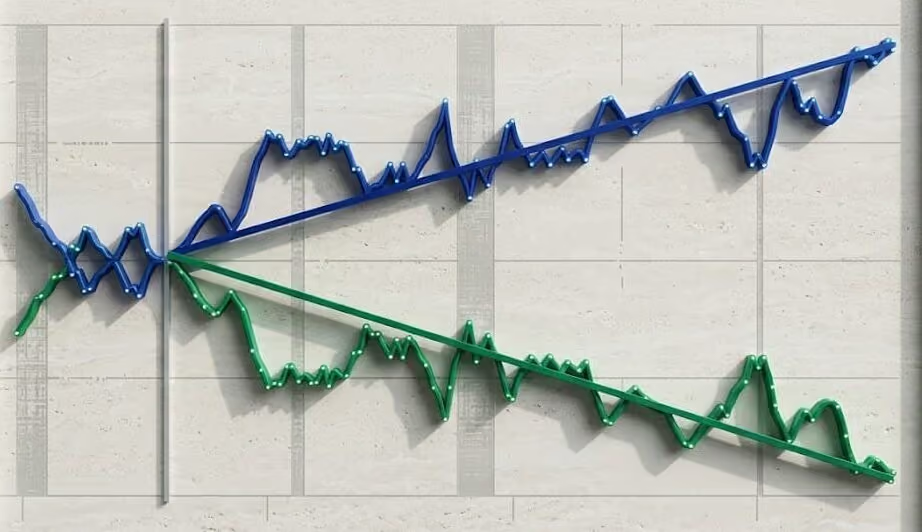
The spending gap has widened into something structural. Moody's Analytics estimates the top 20% of earners now account for 59% of all US consumer spending, up significantly since the mid-1990s, when the top 20% and the bottom 80% of earners each held roughly 50% of spend. This diverging trend line, where share of spend for the top 20% goes up and spend for the bottom 80% goes down, is what the industry has deemed the K-shaped economy.
You can see it inside a single retailer. In its latest earnings, Walmart said the majority of its market-share gains came from households earning more than $100,000, even as it noted that shoppers earning under $50,000 are stretched and, in some cases, living paycheck to paycheck. The same company, in the same quarter, describing both arms of the K.
Deloitte's research finds value-seeking has become structural and now reaches every income tier, including households earning more than $200,000. The income spread inside your four walls is wider than it has ever been. Higher-income shoppers are seeking a premium experience and top-quality items while still demanding competitive prices on essentials, and the rest are making tough decisions around how and where they shop and what they buy, even skipping some purchases altogether.
Does a single pricing strategy still work in a K-shaped economy?
For years, a grocer could pick a posture, hi-lo or everyday low price, commit to it, and build an identity around one definition of value. That worked when shoppers shared one definition. They no longer do.
Value now means different things to different people in the same aisle. For the budget-pressed shopper, value is a sharp everyday price on the items they buy every week and straightforward promotions. For the trade-up shopper, value is freshness, quality, and an assortment worth paying a little more for. And shoppers move fast when either one slips. AlixPartners finds three in four consumers have changed how they shop for groceries under financial pressure, with many now cherry-picking fresh from one banner and shelf-stable from another.
The real risk is not one dramatic price war, but quiet churn on both ends at once. Price your Key Value Items (KVIs) poorly and the value shopper drifts to the banner that's cheaper. Thin out fresh and premium and the trade-up shopper takes that half of the basket elsewhere. Since price drives 87% of how shoppers perceive value in grocery (the highest of any industry), a weak price image is very hard to win back once it sets. Price is not the whole story, though. Quality, freshness, and trust are additional factors in price image, and they are what hold the shopper who is trading up. You have to compete on both.
What is everyday fair pricing?
Everyday fair price is not everyday low price under a new name. Everyday low price (EDLP) holds one low posture across the whole store. Everyday fair price (EDFP) sets the right price for each item, based on the job that item does. It is an evolution of both hi-lo and EDLP, not a repudiation of either.
In practice, two moves run at once:
Value-seeking shopperTrade-up shopperJudges you onEveryday price on KVIs and opening price points, straightforward promotionsFreshness, quality, premium and own-brand assortmentYour moveHold a sharp, visible price image on KVIs; eliminate complex, ineffective promotions while investing in those that move the needleCapture margin in the categories or items where price sensitivity is lowerWhy it worksPrice drives 87% of grocery value perceptionLoyalty is built through quality and experience
What makes it work is knowing each item's job. Some products are KVIs that set your price image, others are there to carry margin, and most sit in between. Price them by that role, account for KVI status and what nearby competitors charge, and adjust for regional differences across your stores. Do that and you hold a sharp price image where shoppers are watching, while protecting margin everywhere else. That is how you build margin without buying it with price cuts.
How can a lean regional team run this without a national chain's headcount?
Doing this well, across thousands of items, hundreds of stores, and a competitive set that moves weekly, is a fundamental data challenge. National chains already price this way, with dedicated data scientists and custom-built systems. A regional grocery or convenience operator often runs the same jobs with a much smaller team and less access to useful data. These operators are outgunned on infrastructure, not on effort.
That gap is closing. Pricing and promotion optimization technology can now let a lean team hold KVI discipline across the whole assortment, surface the promotions that are not working, produce recommendations merchants will adopt rather than override, and give each analyst back about 8 hours a week, a full working day for the judgment that sets a store apart.
In practice, that means moving KVI pricing compliance close to 99%, and retiring the roughly one-third of promotions industry-wide that don't work as intended.
ClearDemand worked with one premium grocer who has grown profit 2.78%, with a 4.81% lift in frozen and 3.13% in grocery, built on measuring value rather than cutting prices across the board. Another convenience chain grew gross profit by up to 20% on the same discipline. The pricing science that used to belong only to the largest chains is now within reach of the operators competing hardest for both ends of the aisle.
The takeaway for regional grocers
For grocers, the K-shaped economy isn't a prediction. It's already impacting shoppers in stores today, one basket at a time. The operators who hold both ends of the income spread will be the ones who stop pricing for an average shopper who no longer walks in and start pricing for the two who do.
ClearDemand is the only platform that unifies competitive intelligence, price, and promotion in one system, purpose-built for grocery and convenience. See how regional operators price for both ends of the aisle with everyday fair pricing.
Ready to deploy everyday fair pricing? Request a demo.
Frequently asked questions
What is the K-shaped economy in grocery?
It describes a widening split between higher- and lower-income shoppers who increasingly buy in the same stores. Higher-income households drive a growing share of spending and trade up on fresh and premium, while lower-income households feel more price pressure and lean toward private label and shelf-stable goods. One store now serves two very different definitions of value.
Do high-income shoppers still care about price?
Yes. Deloitte finds value-seeking now reaches every income tier, including households earning more than $200,000. Higher-income shoppers still notice a weak price image on everyday items. They simply weigh freshness, quality, and assortment more heavily once price is competitive, which is why a grocer has to earn both.
Can a grocer run hi-lo and EDLP at the same time?
Effectively, yes, when pricing is set by item role rather than as one store-wide posture. KVIs can hold a sharp everyday price to protect price image, while other categories carry margin or run promotions. The point is not to pick one strategy for the whole store, but to apply the right one to each item. That blend is everyday fair pricing.
How do lean pricing teams keep both budget and premium shoppers loyal?
By protecting price image on the items shoppers judge them on, capturing margin where price matters less, and executing that consistently across every store and cycle. Price and promotion optimization carries the volume, so a small team can hold that discipline at national-chain scale.
What are KVIs, and why do they matter to price image?
KVIs are the products shoppers use to judge whether a store is affordable, often staples like milk, eggs, and other frequently bought goods. Because price drives 87% of grocery value perception, staying sharp on KVIs protects the price image that keeps value-seeking shoppers from leaving.
Related articles
See it on your own data
Bring your categories and competitive set. See what the model recommends, and why.