Why ecommerce data belongs at the core of your competitive strategy

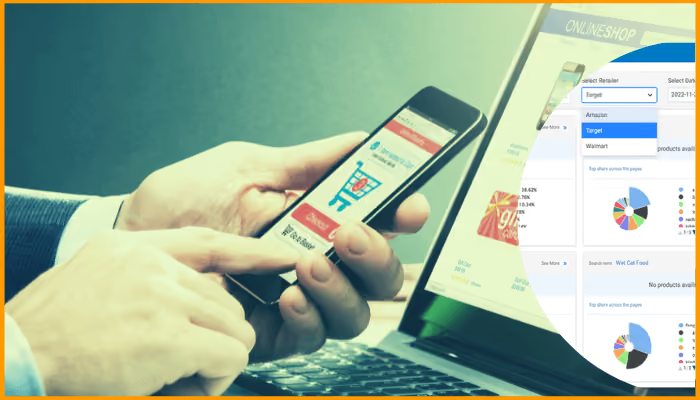
Forward-thinking retailers incorporate ecommerce data into their competitive strategy.
Even grocery retailers need online data to compete and better serve their customers. It captures attributes like product description, pricing, and shipping information – giving you insights into the competitive landscape. Retailers that collect and act on ecommerce data can measure price perception, understand assortment positioning, and make confident moves that protect profit and shopper trust.
If you’re not leveraging web data in your business strategies, then it’ll be tough to build loyalty and position yourself against the competition.
The Power of Product Matching
It all starts with capturing data, then once the data is gathered the next step is product matching.
Product matching identifies the same, similar, or equivalent products across competitive catalogs. Retail businesses use product matching for price benchmarking, assortment gap identification, promotion monitoring, and an overview of the competitive landscape.
Some retailers spend (too much) time manually searching competitors’ websites for this information. Some retailers rely on imperfect product comparisons. These subpar methods are not “good enough”. Think about it like this: If you rely on UPC matching alone, you’re missing out on pack sizes, product variations, and all those products from retailers who don’t display UPCs. Not to mention if there’s errors or changes to the UPCs, the link breaks and you’re left with another blind spot.
While product matching isn’t easy or straightforward, when it’s done right, it gives retailers a serious upper hand.
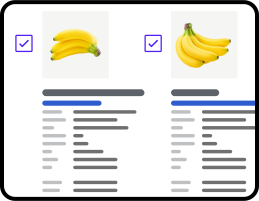
To get it right, retailers are turning to product matching solutions that are driven by machine learning algorithms. This way, retailers have high-quality data of the competitive environment. There are so many advantages to accurate, automated product matching: price optimization, changes to assortment, and confident decision making.
Accurate product matching gives retailers the ability to…
- Identify assortment gaps
- Align on promotional strategies
- Optimize prices
- Understand the competitive landscape
- See out of stocks
Omnichannel Shoppers Drive Growth
And all that data collection and product matching accuracy and consistency is important because shoppers are Omnichannel shoppers are your most valuable audience — and they’re everywhere.
- 60–70% of consumers say online browsing and social media have become their new way to shop (McKinsey).
- 47% of shoppers buy additional items in-store when picking up an online order.
- By 2026, 24% of all retail purchases are expected to happen online, totaling more than $8.1 trillion globally.
This shift means your online presence defines your price image. Shoppers compare prices, check availability, and evaluate promotions long before they step foot in a store. Without unified, high-quality ecommerce data, you can’t deliver the seamless experience they expect — or the margin results you need.
Poor Data Is Costing You Margin
When data is inaccurate or incomplete, your decisions are too.
Retailers tell us the same thing again and again: their biggest barrier to growth isn’t technology — it’s data quality.
That’s why ClearDemand focuses on accuracy, automation, and scalability. We deliver clean, complete, and continuously refreshed competitive data so your team can focus on analysis, not cleanup.
Poor data leads to missed opportunities. Quality data creates confidence and profit.
Competitive Pricing
One major benefit to product matching and competitive intelligence, is the visibility into prices across the market.
It’s no surprise that consumers look at price when making a purchase; 77% say it’s vital part of their purchase decision. This number increased 23% since 2022 as more consumers look for ways to save.
No matter your retail vertical, shoppers are comparing prices online.
- For pet supplies.
- For cars & auto accessories.
- For groceries.
- For tools.
- For travel.
- For school and office supplies.
- For clothes.
Why?
- Lower prices.
- Convenience.
- Free shipping.
- Curbside pickup.
- Product availability.
- Customer service.
Do you have enough data to optimize your competitive strategy?
Retail Strategy Optimization
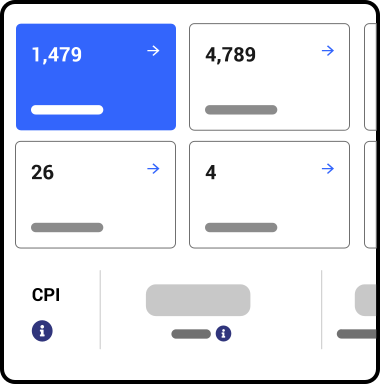
Your online price, assortment, availability, and promotional strategy present a huge opportunity for growth. To build a blueprint of success, you need accurate ecommerce data, that is then matched across catalogs, so that you can be hyper-focused on optimizing price and assortment.
- If you want to understand regional pricing, you need data.
- If you want to understand who your competition is, you need data.
- If you want to build a pricing strategy around margins, you need data.
- If you want to understand if you have assortment gaps, you need data.
Data will do more than solve your problems. Data drives results.
Beyond the data, you need a scalable and automated process. Build your foundation with a data partner that you can trust. That means quality data, total coverage, and transparent customer support.
Here’s just some of the benefits you gain with ecommerce data and product matching automation:
- Determine who your biggest competitors are in any market
- Say which products are the same or what the price-pack architecture differences are
- Create real value for your customers by offering the best prices and shipping options
- Keep assortment fresh and add relevant products to your selection
- Understand the competitions’ promotional events and fine-tune your own efforts
- Build meaningful experiences using differentiated content from Generative AI
- Use the power of machine learning to automate backend operations
What About Syndicated Data?
Syndicated data tracks customer behavior. It gives retailers an overview of demographics, purchase frequency, and shopping preferences. It’s an aggregated collection of retail sales market data. Syndicated data compares product information across all stores, food categories, distribution channels, or geographic markets.
And while syndicated data is incredibly useful, it’s not the same as competitive intelligence data.
Competitive intelligence is the collection and analysis of the competitive landscape so retailers can build more informed strategies. These datasets can certainly work together to give your business an edge in the market.
I Need Ecommerce Data... Where Can I Get It?
Our team would love to work with you on a complimentary proof of concept.
ClearDemand delivers:
Seamless integration into price optimization and analytics workflows
Uninterrupted data collection across every channel and competitor
ML-driven product matching for unmatched accuracy
Transform how you meet customers in their buying journey. Get data coverage across all competitors, in any channel, in any zip code, every day.
Related articles

See it on your own data
Bring your categories and competitive set. See what the model recommends, and why.